One eye down. One to go.
The Sacred Everyday

Maybe we should not only be careful what we wish for (most ardently), but also what we take for granted (or even boast about).
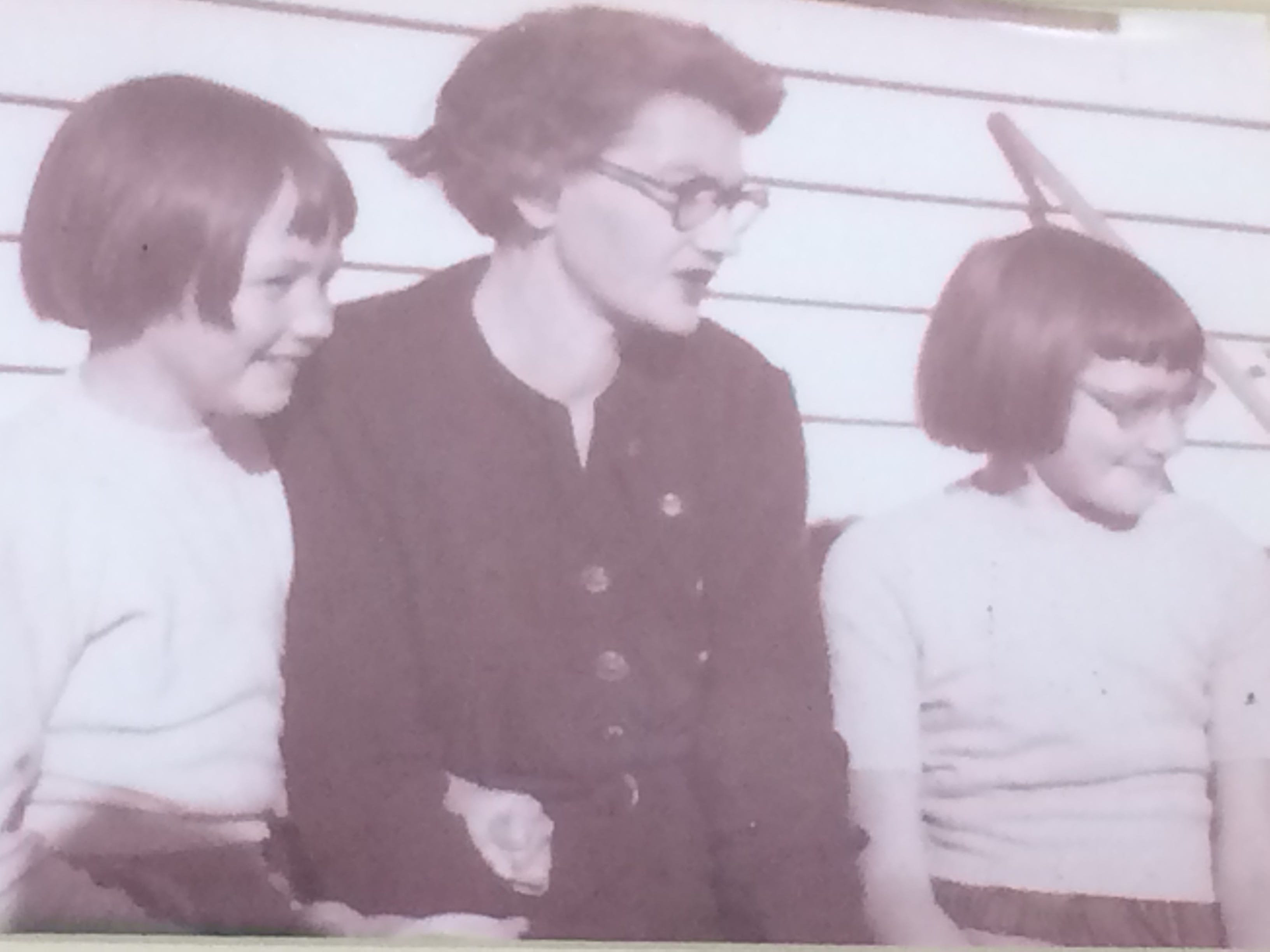
In the photo above, I am the younger daughter who is NOT wearing glasses as both my mother and sister did from the earliest possible ages. My sight was not then or through my long adult life ever a problem. Less than a year ago when I had the obligatory eye test to retain my old person’s driver’s licence I passed without reading glasses.
Other health problems have meanwhile caused much grief. Most especially a couple of tumour-invasions; as seriously, the galloping osteoporosis that stemmed at least in part from breast cancer in my forties and the subsequent depletion of estrogen that plays a part in the reduction of bone mineral denisty that can lead to painful debilitating fractures, even without falling.
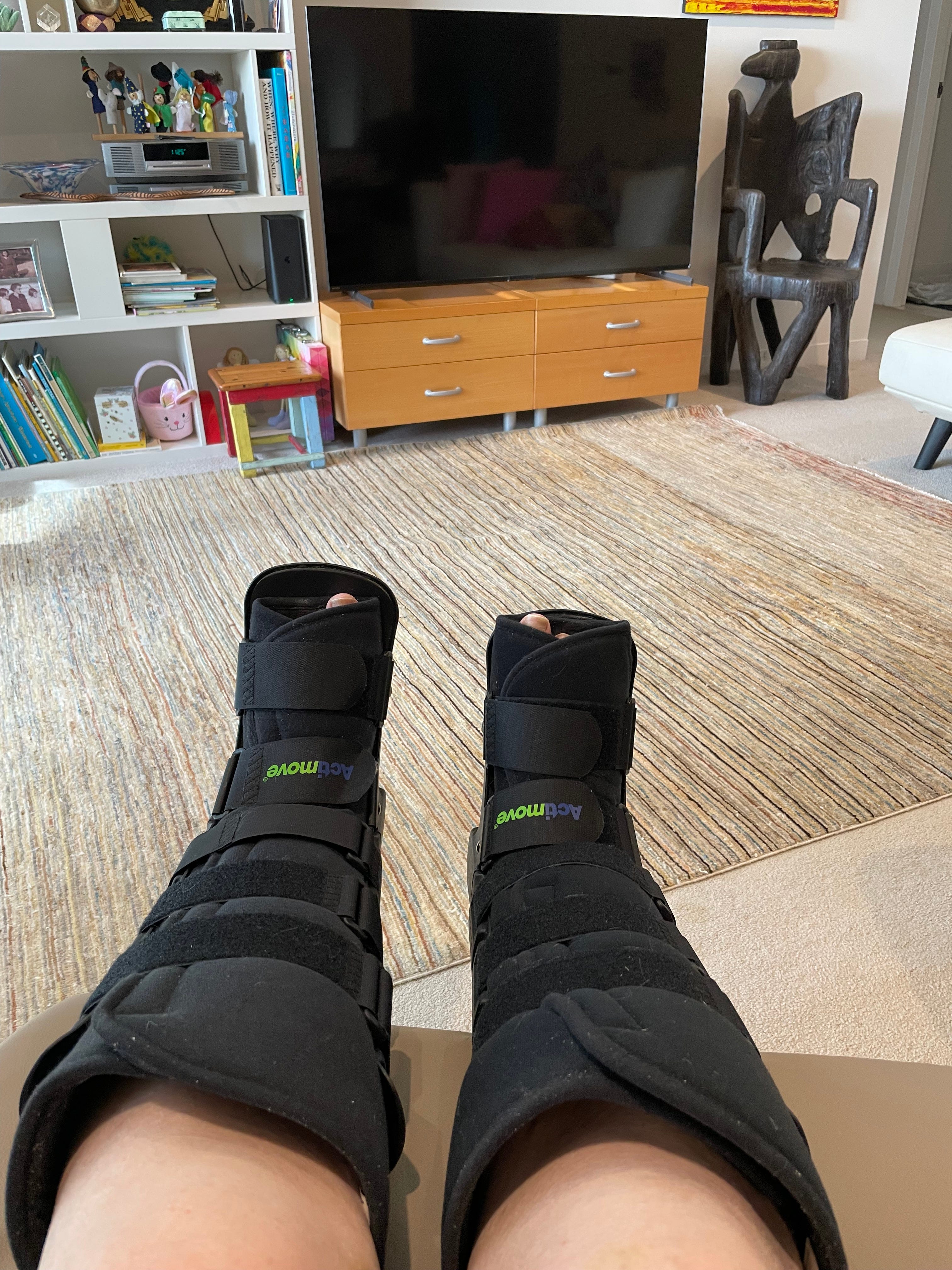
Those rather inelegant boots above encase my latest fractures, not the spine this time (thank heaven) but a SPONTANEOUS fracture in my right ankle (so that my whole body collapsed as I tried to stand in my living room) plus a “matching” fracture in the left ankle that occurred as my body sank to the carpeted floor.
There is a great deal that I could write about #osteoporosis. And I will some day soon. Enough here to add that it is only thanks to the latest drugs that I am as relatively functional as I am.
My beautiful mother, pictured above, had died of (a different) cancer two years before her fortieth birthday. Such was medicine in the 1950s. My tussle with breast cancer was unremarkable (survival rates after five years can be as high as 97 per cent). It’s the longer-term consequences that I live with now.
The advances in medication I have most needed and taken up are a) to preserve and b) to increase bone density, saving me from a wheelchair or worse after up to nine spinal fractures as well as this latest ankle-moonboots-yet-again-in-rehab drama.
BUT, that’s meanwhile context only for now - and so back to the smugness I felt when flying through with a self-awarded medal the eye test for my licence renewal.
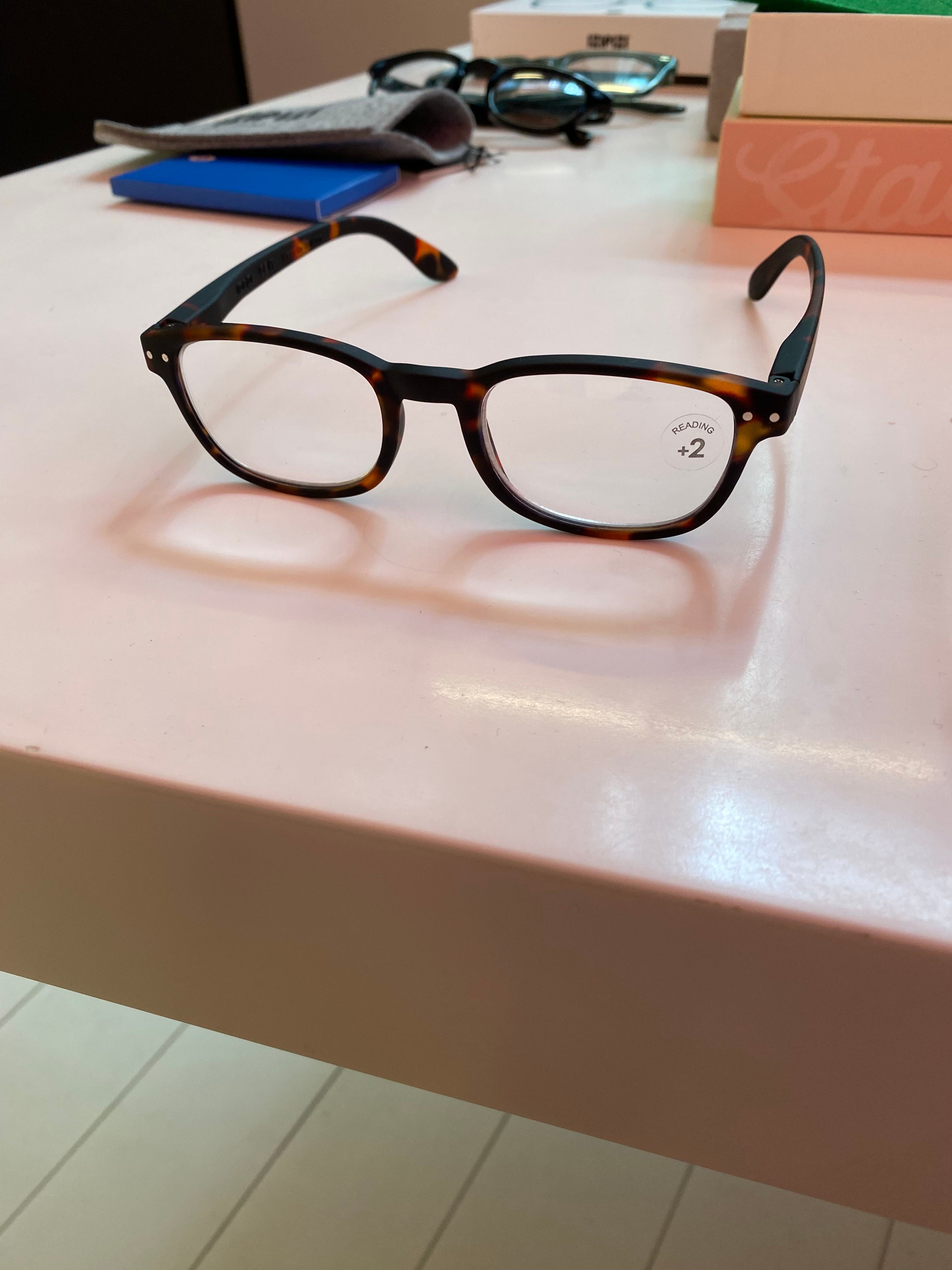
Around March this year, when I was just in post-rehab for the latest cracks in my SPINE (L1 and L3: fully “ouch”, in fact, vile), I noticed with a surprise that dented aforementioned smugness that I was reading significantly less well. Small type in print editions of books was definitely defeating me. I was preferring (for that reason only) to grab my Kindle. Worse, I was squinting at the screen of my laptop when writing (my professional work), and finding it harder to read the closed captions I prefer on the television… Ah, reading glasses I presumed were needed. A small blow, but to pride only and not a big deal. After all… etc etc.
Reading glasses are crazy cheap. I bought not one but several pairs.
Come forward to July of this year and one particularly frustrating day I did what a more sensible person might have done months earlier. I covered my right eye with my hand. And read as well as I was then normally doing. Then I covered my left eye with my hand…and could read nothing at all.
On a scale of 0-10, this scored a 10 for surprise, a 9 for “why didn’t you do this earlier”, and only a 5 for worry. A cataract, I told myself. No worries. A short procedure, always successful, and on we go.
“I have a cataract in my right eye,” I confidently told the orthoptist taking the scans and measurements before I was ushered in to see an ophthalmologist. “Who diagnosed this,” she asked. “I did!” Hmmm.
Absolutely no prizes for guessing that when I did see the ophthalmologist minutes later he had to break the bad news: no easily-removed cataract; a bad bleed behind the retina had caused irreparable scarring and what he called “debris” left in my eye; no injections possible; permanent loss of central vision.
“Permanent” apparently means for the rest of your life.
Loss of central vision means you cannot see faces. Or read. Anything. With that eye.
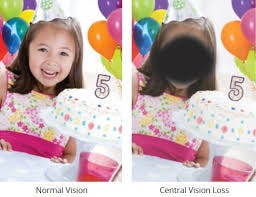

The bleed behind the retina was caused, I now understand, by AMD (age related macular degeneration that is in part, well, age related, also genetic.
From the age of 45, it is wise to take yourself and your precious pair of eyes to the best possible optometrist you can find to be checked, checked, checked for any signs of macular disease. This is as important as a routine breast check or anything else equivalent in the male body. I did not know this.
Only a week or so later, I did additionally visit a retina surgeon. He was far less sympathetic than the first specialist had been, declaring this the result of “wet” macular disease, and warning of the presence of “dry” MD in my precious sole-functioning left eye. (It was 5.30pm when I walked out of the building, sat on a chair outside the closed cafe, and cried.)
Dr First had understood that reading (including the faces of those I love) and writing are two activities utterly central to my wellbeing and life. Dr Second saw me, I fear, as pair of old eyes attached to a credit card. Not good. Nor supportive or encouraging in any way.
The person who did give me far greater insight and practical information was the optometrist I eventually tracked down. She requested and got the scans from the ophthalmology practice, told me she could not prescribe useful glasses for six months or so until my brain adjusts, recommended reading glasses that were less strong than those I had bought from pharmacies and Temu, and also went to the effort of referring me to Australia’s Macular Disease Foundation where personal support as well as more general information is offered free and with exceptionally empathic professionalism. (A healthy diet and lots of exercise is as necessary for eye health as for any other part of the body. Huzzah.)
My current sight - with one “good” eye - does not, cannot match my pre-retina bleed sight. I have a persistent and sometimes intrusive shadowing to the right of the right eye. And, all round, I have lost the sharpness of vision that was so precious and essential to a life of writing and reading.
Where to from here?
I will chose to have 6-monthly scans with the skilled optometrist I was so lucky to find. If I notice ANY peculiarities with my sole fully-functioning eye, I am encouraged to go to the outpatients of a specialist or tertiary hospital immediately. I certainly will.
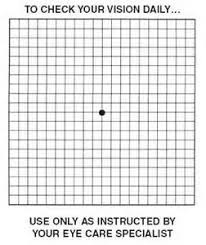
A chart like the one above is in my kitchen. I have learned to rest my eyes with a “weighted” eye mask placed over a damp cloth (the advice I received should be CHECKED with your own health professionals).
I am struggling to see efficiently, as healthy as my left eye remains. Reading glasses as newly recommended, my very mild old distance glasses: neither helps much. Because broken ankles get the kind of immediate attention and understanding that spinal fractures do not, and a “pirate eye” does not either, it is relatively difficult to convey what a quiet, dismaying disturbance this sight loss can be.
Yet, I have learned from it.
Care BETTER and with MORE KNOWLEDGE for what matters to you most. Encourage your loved ones similarly.
Where medical specialists are, like Dr Second, less than understanding, move right along. My life is enhanced immeasurably by the health and medical practitioners who do see a person and not “just” a disease. Getting older is a privilege my own mother did not enjoy. I mourn that for her as well as mourning her. Getting older, though, is also a process of discovery. We come to it as newcomers. Every day. Sharing what we know, sharing what is evidence-based and authentically helpful, is essential to wellbeing and connection.
We are in this life together.
Rev Dr Stephanie Dowrick (Ph.D, D.Min) has had a long career as a publisher, writer, psychotherapist, mental health researcher and interfaith spiritual leader. Her books include Seeking the Sacred: Transforming Our View of Ourselves and One Another, Forgiveness & Other Acts of Love, Creative Journal Writing, and Your name is not Anxious (published in the US by St Martin’s Press and in ANZ & the UK by Allen & Unwin). She can be contacted via her website or public Facebook page.
It is truly remarkable that you are writing with so much clarity and generosity given all the inconveniences and discomforts you are living with Stephanie, thank you so much. May you find more ease and continue to enjoy the gift of positivity and overview. With Love, Candy
Thank you for sharing.